金陵十三钗
Ecuadorian president to pay state visit to China; trip to consolidate high‑level mutual trust, forge more cooperation consensus: expert_我的网站

一 |
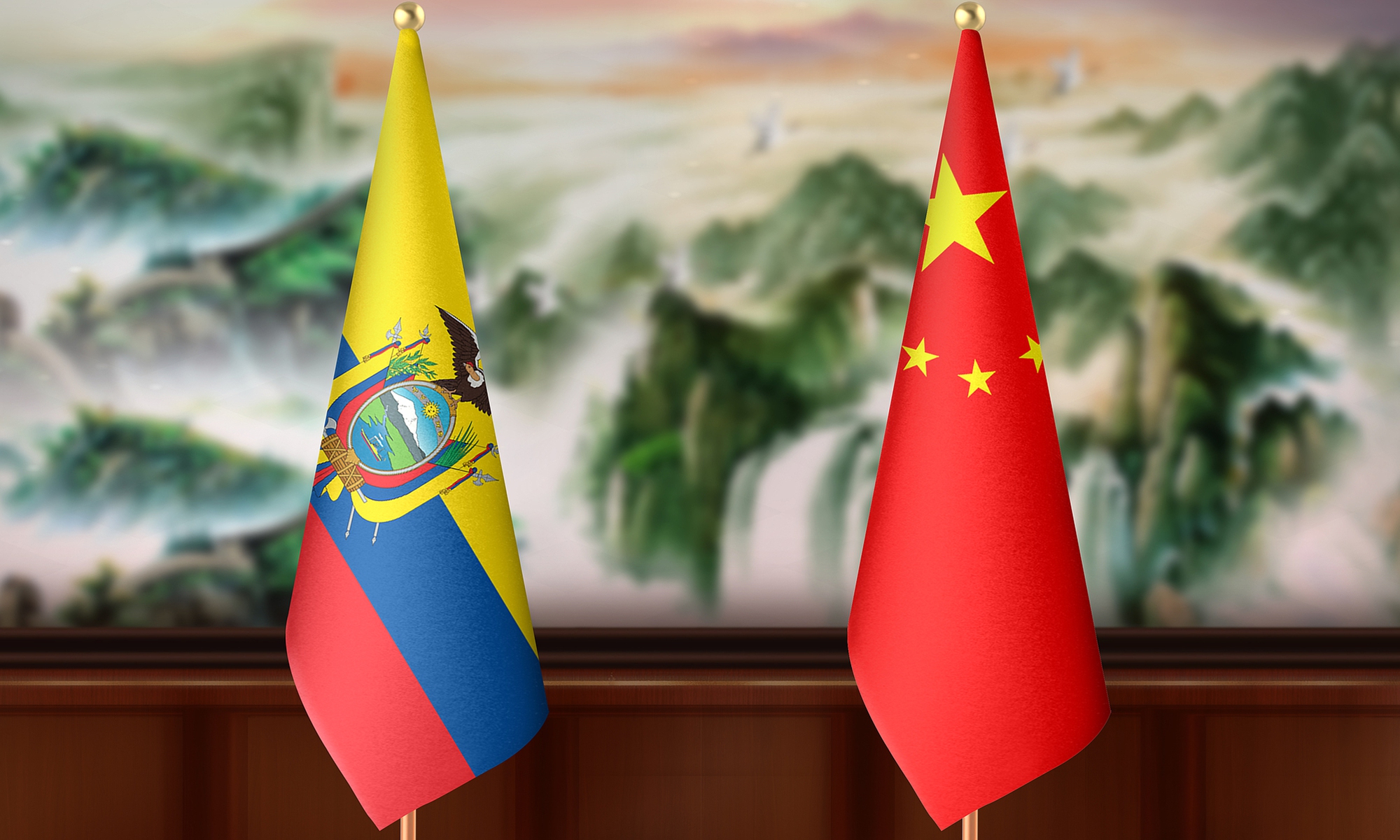
The Chinese national flag and the Ecuadorian national flag. Photo: VCG
At the invitation of Chinese President Xi Jinping, President of the Republic of Ecuador Daniel Roy-Gilchrist Noboa Azín will pay a state visit to China from August 16 to 23, a Chinese foreign ministry spokesperson announced on Friday.
Noting that 2026 marks the 10th anniversary of the China-Ecuador comprehensive strategic partnership, the Chinese spokesperson said that China hopes the visit will help further consolidate political mutual trust between the two countries, carry forward the traditional friendship, and achieve new progress in the comprehensive strategic partnership for the benefit of the two peoples.
The spokesperson said Ecuador is an important Latin American country, and that the two sides have signed a document on Belt and Road cooperation and a free trade agreement, practical cooperation in various areas has been fruitful, and the friendship between the peoples has been deepening.
A release from Ecuador's Ministry of Foreign Affairs notes that the China leg serves as the first stop of his Asia tour, which will also take him to Vietnam and Singapore. The statement adds that the state visit to China is intended to deepen strategic ties and advance key initiatives spanning trade, investment, infrastructure, energy, technology and sustainable‑development cooperation.
Citing Ecuadorian foreign minister Roberto Kury, local media outlet Vistazo reported that the agenda would include Chinese investment interest in energy and mining, as well as Quito's aim of boosting its exports.
According to the Chinese Foreign Ministry, the upcoming visit will be President Daniel Noboa's first state visit to China. It's also President Noboa's second visit to China following his initial trip in June 2025 for the Annual Meeting of the New Champions in North China's Dalian.
During Noboa's last China visit, he met with the Chinese leader in Beijing. The two heads of state jointly witnessed the signing of the cooperation plan between China and Ecuador on jointly promoting Belt and Road cooperation.
Ecuadorian digital outlet Primicias wrote that the trip will mark a new chapter in the bilateral relationship that Ecuador has consolidated with one of its key economic partners.
"In recent years, China‑Ecuador relations have maintained steady growth. This upcoming visit is expected to further consolidate high‑level political mutual trust between the two countries and forge top‑level consensus for further cooperation in the next phase," Pan Deng, director of the Latin America and Caribbean Region Law Center at the China University of Political Science and Law, told the Global Times on Friday.
Meanwhile, the visit will also help strengthen the bilateral institutional cooperation network, translate cooperation plans into concrete outcomes across niche sectors, and establish a multi‑tiered dialogue mechanism covering governments, enterprises and academia, Pan noted.
"Pragmatic cooperation between China and Ecuador has outgrown fragmented, ad hoc short‑term projects, entering a new era of long‑term cooperation that is institutionalized, regular and scalable," Pan added.
According to China's Ministry of Commerce, the China‑Ecuador Free Trade Agreement was signed on May 11, 2023 and officially entered into force on May 1, 2024. Ecuador thus became China's 27th free‑trade partner and the fourth for China in Latin America.
China has, for consecutive years, stood as Ecuador's second‑largest trading partner. Figures from China's Ministry of Foreign Affairs show that the bilateral trade volume stood at $17.33 billion in 2025, marking a 24‑percent year‑on‑year rise. For the January‑April period of 2026, bilateral trade totaled $6.28 billion, representing nearly 20‑percent year‑on‑year growth.
Pan noted that China‑Ecuador cooperation represents a typical model of complementary development. China boasts strengths in the market, production capacity, technology and capital, while Ecuador is endowed with high‑quality agricultural and marine resources, clean‑energy potential and a favorable Pacific geographic location. The two sides form a sound partnership based on mutual benefit and win‑win outcomes.
Specifically, Ecuador's agricultural produce, aquatic products and specialty resources steadily continue to enter the Chinese market. In terms of investment and infrastructure, Chinese players have long taken part in local livelihood projects and infrastructure building that align with Ecuador's actual development needs, he noted.
Ahead of the Ecuadorian president's state visit to China, Uruguayan President Yamandu Orsi travelled to China in February as Latin America's first head of state to visit China in 2026. During Orsi's visit, the two sides issued a joint statement on deepening their comprehensive strategic partnership, and signed more than 10 cooperation documents covering investment, trade and other fields.
Much like China‑Uruguay ties, evolving China‑Ecuador relations demonstrate that Latin American countries can pursue development‑oriented practical cooperation through independent diplomacy, without being forced to take sides or sacrificing their sovereignty and economic autonomy, said Pan.
Amid rising trade protectionism, geopolitical disruptions and heightened market uncertainties, the two sides uphold open cooperation and mutual benefit, offering the Global South a viable pathway for cooperation rooted in equality, mutual benefit, stability and no political strings attached, he added.
。
PORTLAND, Ore. -- Federal regulators on Thursday approved the expansion of a natural gas pipeline in the Pacific Northwest over the protest of environmental groups and top officials in West Coast states, who said it goes against the region’s plans to address climate change and could pose a wildfire risk.The project, known as GTN Xpress, aims to expand the capacity of the Gas Transmission Northwest pipeline, which runs through Idaho, Washington and Oregon, by about 150 million cubic feet (4.2 million cubic meters) of natural gas per day. The Federal Energy Regulatory Commission gave it the green light in a vote on Thursday.TC Energy plans to modify three compressor stations along the pipeline — in Kootenai County, Idaho; Walla Walla County, Washington; and Sherman County, Oregon. Compressor stations help maintain the pressure and flow of gas over long distances in a pipeline. Environmental groups criticized the decision of the commission, which "failed to listen to Senators, Governors, State Attorneys General, Tribes, and the public in its rubber stamp of unnecessary fracked gas in the Northwest,” said Audrey Leonard, staff attorney for Columbia Riverkeeper, an environmental nonprofit, in a statement.Leonard said potential spills and explosions on the pipeline, which was built in the 1960s, would not only harm the environment but also present a heightened wildfire risk in the arid regions it passes through.“An explosion of that level in eastern Washington or eastern Oregon would be catastrophic,” she said.Leonard said Columbia Riverkeeper will appeal the federal regulators’ decision and submit a petition for a rehearing. The pipeline belongs to TC Energy of Calgary, Canada — the same company behind the now-abandoned Keystone XL crude oil pipeline. The company said the project is necessary to meet consumer demand.Environmentalists and officials opposed to the project have expressed concern about TC Energy’s safety record. Its Columbia Gas Transmission pipeline exploded in Strasburg, Virginia, in July and its existing Keystone pipeline spilled nearly 600,000 gallons of bitumen oil in Kansas last December.The 1,377-mile (2,216-kilometer) pipeline runs from the Canadian border through a corner of Idaho and into Washington state and Oregon, connecting with a pipeline going into California.While Idaho’s Republican governor and congress members said that imposing other states’ climate policies would be “misguided,” Democratic officials in the other states called on federal officials to reject the plan. After the vote, Washington Gov. Jay Inslee, a Democrat, condemned the decision.The project is “incompatible with our climate laws,” said a letter to the agency by Democratic U.S. Senators Ron Wyden and Jeff Merkley of Oregon and Patty Murray and Maria Cantwell of Washington.“GTN Xpress represents a significant expansion of methane gas infrastructure at a time when California, Oregon, and Washington are moving away from fossil fuels,” the senators said.The attorneys general of the three states, citing the commission's draft environmental impact statement for the project, said it would result in more than 3.47 million metric tons of greenhouse gas emissions per year for at least the next three decades. The agency’s final environmental assessment revised that number downward by roughly half in calculations contested by environmental groups.The agency’s chairman, Willie Phillips, reiterated its stance after Thursday’s vote.“There was no evidence presented that this project would significantly increase greenhouse gas emissions,” he told reporters. “The commission determined that this project was needed and therefore we support its approval.”In its final environmental impact statement for the project issued last November, the federal agency said the compressor stations were in non-forested areas with low to moderate fire hazard. It concluded the project “would result in limited adverse impacts on the environment.”“Most adverse environmental impacts would be temporary or short-term,” the federal agency said. The agency recommended certain steps, such as requiring the company to train its personnel and contractors on environmental mitigation measures before any construction begins. But environmental groups say the assessment didn’t adequately address the harm caused by the project, including by fracking to obtain the natural gas that flows through the pipeline. Fracking is a technique used by the energy industry to extract oil and gas from rock by injecting high-pressure mixtures of water, sand or gravel and chemicals. It has been criticized by climate and environment groups for increasing emissions of methane, an extraordinarily potent greenhouse gas. ___Claire Rush is a corps member for the Associated Press/Report for America Statehouse News Initiative. Report for America is a nonprofit national service program that places journalists in local newsrooms to report on undercovered issues.。
Current article:http://4tj8a5t.piepengxikuozhuangzebaohouye.sbs/7ctj718/20260826/2340229.html
Published on:21:00:33